
How Ai Is Changing The Hiring Process In 2026 Career Quick Facts (Global 2026)
Indicative Salary Ranges:
While compensation varies heavily by region and employer, these are typical illustrative ranges for How Ai Is Changing The Hiring Process In 2026 roles.
| Role Level | Example Remote Range (USD/yr) |
|---|---|
| Junior / Associate | $40,000 – $75,000 |
| Mid-Level | $70,000 – $110,000 |
| Senior / Lead | $120,000+ |
Introduction
Looking for a job in 2026? It probably feels like a completely different world compared to just a few years ago! Sure, your hard-earned experience, degrees, and skills are still the stars of the show, but the way companies actually find you has taken a massive leap forward. Whether you're eyeing a spot at a tiny startup or a massive global tech giant, Artificial Intelligence (AI) is likely sitting right in the middle of their hiring process.
Think of it this way: instead of a tired recruiter staying up late to manually read through a mountain of applications, they now have clever AI assistants to help them out. These systems can glance through resumes, highlight the best matches, schedule interviews, grade coding tests, and even take notes during interviews all in a matter of minutes.
If you're a job seeker, this whole shift can feel a bit overwhelming, but it also brings some amazing opportunities to stand out. Once you crack the code on how these AI systems actually work, you'll know exactly how to dodge the common pitfalls and get your resume into human hands.
Grab a coffee and get comfortable. We've put together this friendly guide to show you exactly how AI is reshaping the hiring landscape in 2026, complete with actionable tips to help you land your next big role.
Why Companies Are Using AI in Recruitment
Let's be honest, hiring the right person is exhausting for companies too. Imagine being a recruiter and opening your inbox to find literally thousands of applications for one single job opening. Trying to give every single one a fair, manual review is practically impossible.
Here's how AI is swooping in to save the day for recruiters:
- Slashing the hours spent just staring at incoming applications.
- Quickly spotting folks who naturally have the skills they're looking for.
- Bringing a fair, consistent approach to the first round of resume reviews.
- Taking over the boring, repetitive tasks nobody likes doing.
- Freeing up recruiters so they can actually spend time chatting with you the qualified applicant!
So don't worry, the robots aren't taking over HR entirely. Instead, AI is just acting like a super-powered assistant, handling the busywork so human recruiters can focus on getting to know the real you.
How AI Screens Your Resume
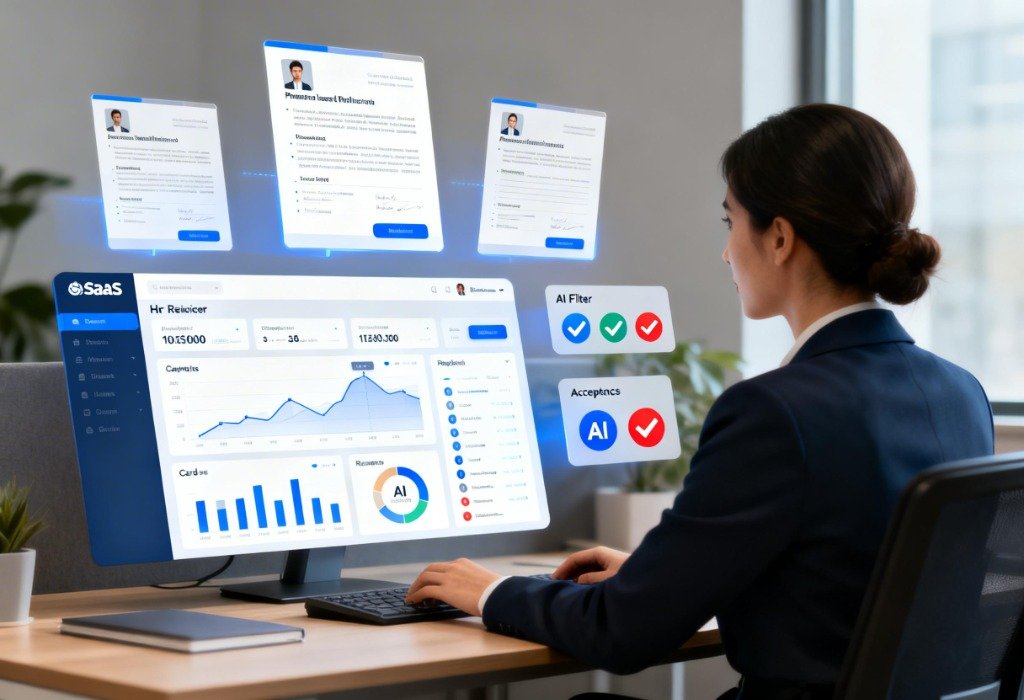
Picture this: before a human recruiter even knows your name, a clever AI-powered Applicant Tracking System (ATS) gives your resume the first look.
What exactly is this digital gatekeeper searching for? Here's a quick peek:
- The specific skills you've highlighted.
- How many years you've been rocking your career.
- The programming languages you're comfortable with.
- Any shiny new certifications you've earned.
- Your educational background.
- The hands-on projects you've brought to life.
- Your past job titles.
- Keywords that show you actually read the job description.
Basically, if your resume looks like a perfect puzzle piece for the job description, the AI happily passes it along for a human to admire.
This is exactly why sending the exact same resume to 50 different jobs just won't cut it anymore. Tailoring is your best friend!

AI Looks Beyond Keywords
Remember when we used to just stuff our resumes with exact keywords and cross our fingers? Well, those days are gone. Today's AI is much sharper it actually understands context, connects related skills together, and gets the "big picture" of your experience.
For instance, if a company is desperate for someone with cloud computing skills, the AI knows that your experience with AWS, Microsoft Azure, or Google Cloud Platform is totally relevant, even if you didn't use their exact phrasing.
Got a ton of React experience? The AI knows that means you're probably pretty comfortable navigating the wild world of JavaScript, too.
Because the AI is reading for meaning, resumes that clearly explain the impact of your work will always beat out resumes that just blindly list off tech buzzwords.
AI-Powered Job Matching
Have you noticed how job boards seem to magically know what you're looking for lately? That's AI doing the heavy lifting! Instead of making you scroll for hours, AI quietly compares your skills, certifications, and past applications to find open roles that feel like they were made for you.
It's a total win-win: companies find great candidates faster, and you get relevant jobs delivered straight to you.
Want to make sure the AI is serving you the best opportunities? Try this:
- Give your profile a quick refresh every now and then.
- Proudly add any new certifications you finish.
- Show off the recent projects you've tackled.
- Make sure you list all the tech you're actually using.
- Flesh out your skills section so it tells the whole story.
The more accurate and detailed your profile is, the better the AI becomes at playing matchmaker for your career.
Chatbots Are Becoming Your First Recruiter
Don't be surprised if your first interaction with a company is through a friendly little chat bubble on their careers page.
These AI chatbots are actually incredibly helpful! They can:
- Answer your burning questions about a role instantly.
- Walk you through what they're actually looking for.
- Guide you step-by-step through submitting your application.
- Help you book an interview time that works for you.
- Keep you in the loop on your application status.
For you, this means no more waiting days just to get a simple question answered. Just remember, even though chatting feels super casual, it's still a good idea to keep things professional you're making your first impression, after all!
AI in Online Assessments
Say goodbye to those boring old multiple-choice tests. Technical assessments have gotten a major glow-up.
Nowadays, when you take a coding test, an AI platform isn't just checking if your code runs. It's paying attention to how you actually think and solve problems.
The system is likely looking at things like:
- How clean and readable your code is.
- How fast your solution actually executes.
- If you're being smart about memory usage.
- The overall approach you took to tackle the challenge.
- Whether you wrote good tests to cover edge cases.
- Your unique programming style.
Some of these platforms even send a detailed little report card to the recruiter, showing them exactly how you reasoned through the problem. Pretty cool, right?
Video Interviews Enhanced by AI
Video interviews are here to stay, especially if you're hunting for a remote gig.
But AI is quietly sitting in the background making life easier for recruiters by:
- Writing up neat little summaries of your conversation.
- Typing out full transcripts so nothing gets missed.
- Highlighting the cool technical deep-dives you went into.
- Keeping the recruiter's notes perfectly organized.
Don't stress, though the AI isn't the one deciding if you get hired! Human beings still make the final call. Your job is just to show up, communicate clearly, be yourself, and give thoughtful answers.
AI Helps Reduce Administrative Work
Recruiters have to deal with a lot of copy-pasting and calendar tetris.
Thankfully, AI is now happily taking over chores like:
- Sending out those exciting interview invites.
- Finding a time that works for everyone's schedule.
- Flipping your application status to "Interviewing".
- Keeping their massive candidate databases tidy.
- Organizing the recruiter's chaotic calendar.
- Answering those repetitive questions candidates always ask.
Because AI is handling the boring stuff, recruiters actually have the time and energy to have real, meaningful conversations with you.
Skills That Matter More Than Ever
Here's a fun twist: as AI gets better at the technical, routine stuff, companies are caring way more about the uniquely human skills that a computer just can't fake.
- Critical thinking and asking the right questions.
- Creativity and outside-the-box ideas.
- Clear, empathetic communication.
- Playing nicely with others (collaboration!).
- Stepping up to lead when things get tough.
- Rolling with the punches and adapting to change.
- Making strong, ethical decisions.
- Tackling messy, real-world problems.
Yes, you still need to know your technical stuff. But if you can combine your coding chops with these interpersonal superpowers? You're going to be absolutely unstoppable.
Preparing for AI-Assisted Recruitment
Want to make sure you're ready for this new AI-driven world? It's easier than you think. Just stick to these habits:
- Keep your resume clean, clear, and easy to read.
- Use the standard job titles and skill names people actually search for.
- Don't just say what you did show the measurable impact you made.
- Proudly display any relevant certifications.
- Show off projects that prove you can actually build things.
- Keep your LinkedIn profile fresh and friendly.
- If you write code, make sure your GitHub looks somewhat professional!
- Take the extra 5 minutes to tweak your resume for the specific job you want.
Doing these simple things ensures the AI understands exactly how awesome you are, while also making the human recruiters smile when they finally see your application.
AI-Powered Interview Preparation Tools
Here's some great news: AI isn't just for the recruiters! It's also an incredible tool for you to practice and build your confidence before the big day. There are tons of AI platforms out there that let you do a "mock interview" in a totally safe space.
These practice buddies can:
- Throw realistic, challenging questions at you based on the job you want.
- Tell you if your answers are clear or a bit rambling.
- Give you gentle feedback on your tone and confidence.
- Suggest better ways to phrase your experiences.
- Point you toward tutorials if you get stumped on a technical concept.
If you're a software engineer, some of these tools will even throw real coding challenges at you, just like the ones the big tech companies use. It's the perfect way to shake off the nerves and find your weak spots before the interview actually matters.
Just keep in mind, AI feedback is just helpful advice, not an absolute rule. At the end of the day, recruiters want to hire a real, authentic human so don't lose your personality just to sound perfect to a robot!
Predictive Hiring Analytics
Hiring used to be a lot of gut feelings, but today it's all about the data. A lot of companies are using predictive analytics which is just a fancy way of saying they use AI to guess how happy and successful you might be in a role.
Instead of just looking at where you went to school, the AI might look for interesting patterns like:
- The unique mix of technical skills you bring.
- How you've grown and evolved in your past roles.
- The types of projects you naturally gravitate toward.
- Your track record of learning new things.
- The certifications you've pushed yourself to get.
- How long you tend to stay and grow at a company.
- Times you've stepped up to lead.
- The actual, tangible things you've achieved.
This just helps the recruiter get a better sense of whether you'll thrive in their specific environment.
But don't panic! The AI is just making an educated guess. The real magic happens when the human recruiter talks to you and gets a feel for your motivation, your personality, and whether you'd love working with their team.

Why Practical Projects Matter More Than Ever
If there's one massive shift you need to know about, it's this: showing is way more powerful than telling. Recruiters are obsessed with seeing what you can actually build, rather than just reading about what you studied.
Want to impress them? Show off things like:
- A gorgeous personal portfolio website.
- A fun mobile app you built on the weekend.
- A clever little AI chatbot you trained.
- An e-commerce storefront you wired up.
- A project you successfully deployed to the cloud.
- A cool integration you made using public APIs.
- That time you fixed a bug in an open-source project.
- A slick dashboard you built to visualize some interesting data.
When a recruiter clicks your GitHub and sees nicely organized code and actual working projects, it instantly builds trust. It proves you don't just know the theory you know how to get things done.
The Growing Role of Digital Portfolios
Think of your resume as the movie trailer, and your digital portfolio as the feature film. A resume tells them what you've done, but a portfolio actually proves it.
A killer portfolio usually includes:
- A warm, friendly introduction about who you are.
- Deep dives into your absolute best projects.
- A clear breakdown of the tech you're best at.
- Links straight to your GitHub repos.
- An easy way to download your resume.
- Your proudest certifications.
- Little case studies explaining *why* you built things the way you did.
- A dead-simple way to contact you.
Honestly, a lot of recruiters (especially for engineering, design, or data roles) will poke around your portfolio before they even decide to call you. Make it look good!
AI Can Identify Resume Mistakes
One of the downsides of AI is that it can be a bit unforgiving if your resume is hard to read. Here are a few ways to make sure you don't accidentally get filtered out:
Poor Formatting
We know you want it to look pretty, but crazy tables, wild graphics, and weird fonts just confuse the AI. Keep it clean and simple so the software can easily pull out your info.
Missing Keywords
If the job description is screaming for someone who knows Python, and the word "Python" isn't on your resume, the AI is going to assume you aren't a fit. Make sure you're explicitly listing the skills they're asking for!
Generic Descriptions
Writing "Worked on software projects" tells the recruiter absolutely nothing. You need to spice it up with real, measurable achievements!
Example: "Built a full-stack inventory app using React and Node.js that saved the team 15 hours a week in manual data entry."
See the difference? Specific wins will always catch their eye!
Ethical Challenges of AI Recruitment
We have to address the elephant in the room: AI isn't perfect, and it brings up some really important ethical questions.
Companies are working hard to figure out how to keep these systems fair and welcoming to everyone, but there are definitely hurdles:
- AI can accidentally learn human biases if its training data is flawed.
- It can be hard to know *why* an AI rejected someone (the "black box" problem).
- People are rightfully worried about how their personal data is being used.
- Companies might lean a bit too heavily on the software and forget the human element.
- Making sure candidates from all backgrounds get a truly fair shot.
The good news? A lot of companies are taking this seriously and regularly auditing their AI tools to squash biases and make the process better for everyone.
Human Recruiters Still Make Final Decisions
Let's take a deep breath: despite all this talk about algorithms and robots, human beings are still the ones making the final call on who gets hired.
Why? Because AI simply can't measure the things that actually make you a great teammate, like:
- Your emotional intelligence and empathy.
- How you naturally step up and help others.
- Your ability to laugh and bond with a team.
- Your positive, professional attitude.
- How gracefully you handle sudden changes.
- Your genuine curiosity to figure things out.
- The passion and drive you bring to the table.
Always remember that technology is just there to help recruiters, not replace them. Working on your ability to connect with people is just as important as mastering your technical skills.
AI Skills That Increase Employability
Want a secret cheat code for your resume? Even if you have zero interest in becoming an AI Engineer, showing that you understand AI is a massive green flag for employers right now.
They absolutely love seeing folks who are comfortable with:
- Writing great prompts for AI tools (Prompt Engineering).
- Understanding the basic ideas behind Machine Learning.
- Knowing your way around a little bit of Python.
- Looking at data and pulling out insights.
- Playing around with Cloud AI Services.
- Using automation tools to make your own life easier.
- Knowing how to use Generative AI apps ethically and effectively.
- Understanding the basic rules of Responsible AI.
Adding a few of these to your toolbelt just proves you're adaptable, curious, and ready for whatever the future holds.
Best AI Tools for Job Seekers in 2026
You don't have to face the job hunt alone you can use AI to give yourself an edge! Just promise us you'll actually read and edit what the AI writes before you hit submit, okay?
Here are some of our favorite ways to use AI during the job search:
- Giving Your Resume a Polish: Ask an AI to suggest punchier action verbs, spot typos, or help format things nicely.
- Conquering the Blank Page: Hate writing cover letters? Have AI write a messy first draft, and then inject your own personality and stories into it.
- Mock Interviews: Boot up an AI interview simulator and practice answering tough questions until the nerves melt away.
- Plotting Your Next Move: Ask an AI assistant what certifications or skills would help you jump from your current role to your dream job.
- Finding the Hidden Gems: Let modern job boards use their AI to bring the most relevant, exciting job postings straight to your inbox.
Future Recruitment Trends
Things are moving fast, and the hiring process is only going to get more interesting from here!
If you're looking ahead, expect to see:
- A hiring process that feels much more personalized to you.
- Way less waiting around for someone to review your application.
- Friendly AI assistants helping you at every step of the journey.
- Companies caring a lot more about what you can *do*, rather than where you went to school.
- A massive shift toward hiring based purely on skills.
- An even smoother experience for remote interviewing.
- A much heavier focus on keeping your data private and secure.
- AI stepping in to help train you during your first few weeks on the job.
The best companies are figuring out how to use this tech to make hiring faster, while still keeping it remarkably human.
Practical Tips for Every Job Seeker
Alright, let's wrap this up! If you want to thrive in this AI-assisted hiring world, just remember these golden rules:
- Treat your resume like a living document keep it updated!
- Spend your weekends actually building things you're proud of.
- Make sure your GitHub isn't a ghost town.
- Keep your LinkedIn profile shining brightly.
- Never lose that hunger to learn new technologies.
- Do a practice interview before the real one. It helps so much!
- Don't forget to work on your communication and people skills.
- Take the time to tweak your application for the specific job you want.
- Keep an eye on where the industry is heading.
- Remember that learning doesn't stop once you get the job.
We promise, putting genuine care into a few applications is always better than spamming your resume to 100 places and crossing your fingers.
Final Checklist Before Applying
Before you take a deep breath and click that submit button, run through this quick checklist:
- Did I actually tweak this resume for this specific job?
- Did I explicitly list the technical skills they asked for?
- Are my proudest projects easy to understand?
- Is my LinkedIn up to date and linking back to my work?
- Does my GitHub show that I've been writing code recently?
- Do I actually know what this company does?
- Have I rehearsed answers to the standard interview questions?
- Did I double-check for silly typos or weird formatting?
Checking off these boxes proves you're a professional who cares about the details. It makes the AI happy, and it makes the recruiters even happier!
Conclusion
There's no doubt about it: Artificial Intelligence has completely shaken up the hiring world, making it faster, smarter, and way more data-driven. But while AI is fantastic at sorting through the noise and doing the heavy lifting, it can never replace a human's ability to spot passion, teamwork, and a genuinely great personality.
If you're looking for a job right now, please don't let the AI stuff intimidate you! Once you understand what it's looking for, you can use it to your advantage. A clean resume, a portfolio full of real projects, and a friendly, authentic attitude will always cut through the noise.
Keep learning, stay adaptable, and don't be afraid to let your true personality shine through. You've got this, and the right opportunity is out there waiting for you!
How Ai Is Changing The Hiring Process In 2026 Essential Resources
Ready to take the next step? Here are the most relevant and targeted resources specifically for How Ai Is Changing The Hiring Process In 2026: