

Python Career Quick Facts (Global 2026)
Indicative Salary Ranges:
While compensation varies heavily by region and employer, these are typical illustrative ranges for Python roles.
| Role Level | Example Remote Range (USD/yr) |
|---|---|
| Junior / Associate | $75,000 – $115,000 |
| Mid-Level | $110,000 – $155,000 |
| Senior / Lead | $150,000+ |
Often referred to as the "Swiss Army Knife" of programming languages, Python has dominated the tech world through sheer versatility and readable syntax. Whether you are automating tedious administrative workflows, building scalable backend web servers, or training complex Large Language Models (LLMs), Python is the connective tissue that powers modern technology ecosystems. It is no exaggeration to say that learning Python in 2026 is less of an option and more of a prerequisite for diverse engineering roles.
Python has exploded into one of the most popular programming languages on the planet because it's just so simple, powerful, and wildly versatile. Unlike a lot of other languages that make you wrestle with confusing syntax, Python was practically designed to read and write like everyday English. That makes it an absolutely fantastic choice if you're a beginner, while still packing enough punch for seasoned developers tackling really complex projects.
Today, you'll find Python being used everywhere from scrappy startups and universities to research labs and some of the biggest tech giants in the world. We're talking about companies like Google, Netflix, Spotify, Instagram, NASA, and Dropbox, who all rely on Python to keep their software systems running smoothly.
One of the absolute best things about Python is its incredible flexibility. Learning it doesn't lock you into just one career path. Instead, it swings the doors wide open to exciting fields like web development, data science, AI, cybersecurity, cloud computing, game development, and automation.
What is Python?
At its core, Python is a high-level, general-purpose programming language. It was created by Guido van Rossum and first launched way back in 1991. The big idea behind it? Making programming way easier to read, write, and understand.
While many languages bog you down with complicated symbols and rules, Python is all about simplicity. Its clean structure means you can spend your time actually solving problems instead of fighting with your code. Honestly, this simplicity is exactly why Python is hailed as one of the most beginner-friendly languages out there.
For example, if you just want to print a simple message to the screen, it only takes one short line of code:
print("Hello, World!")It's that straightforward syntax that makes Python the perfect starting point if you've never typed a line of code in your life.
Why is Python So Popular?
Python has won the hearts of developers all over the world because it strikes the perfect balance between being easy to learn and incredibly powerful. Here are just a few reasons why we all love it so much:
Easy to Learn
Python's syntax is refreshingly straightforward. It looks a lot like plain English, which makes grasping programming concepts so much less intimidating for beginners.
Versatile
You can use Python for just about anything! Whether you're into Web Development, Artificial Intelligence, Machine Learning, Data Science, Cybersecurity, Automation, Cloud Computing, or even Game Development, Python has you covered. Learning it means you have the freedom to explore different paths without having to learn a whole new language from scratch.
Large Community
There are millions of developers using Python right now. So, if you ever get stuck on a problem, don't worry there's a really high chance someone else has already figured it out and shared the solution online.
Huge Collection of Libraries
Python comes with thousands of ready-to-use libraries that act like cheat codes for developers. Need to do some heavy lifting? You can lean on popular libraries like NumPy, Pandas, Matplotlib, TensorFlow, PyTorch, Django, Flask, OpenCV, BeautifulSoup, and Requests.
These handy tools save you a ton of time, letting you build powerful apps without having to reinvent the wheel every single time.
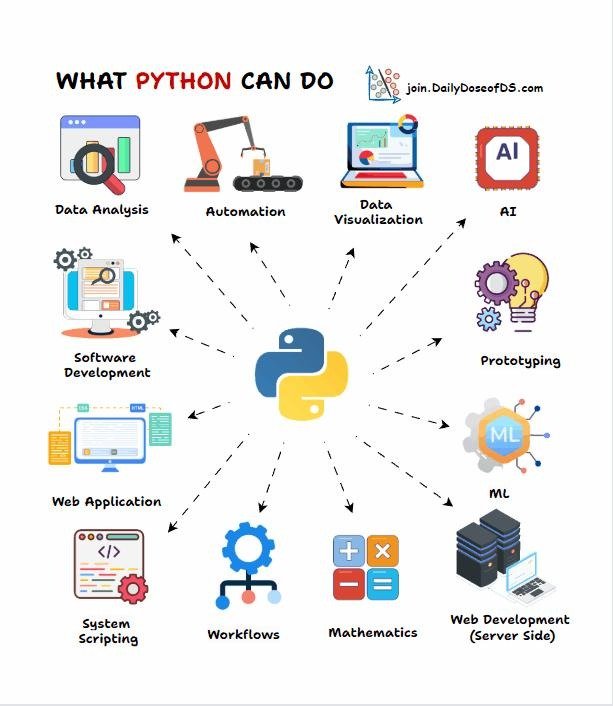
Where is Python Used?
One of Python's biggest superpowers is how broadly it can be applied. Rather than being stuck in one niche, you'll find Python working its magic almost everywhere.
Web Development
People love using Python to build websites and web apps. With awesome frameworks like Django, Flask, and FastAPI, developers can quickly whip up web applications that are secure, scalable, and easy to maintain.
Artificial Intelligence and Machine Learning
If you want to get into AI, Python is the undisputed king. Libraries like TensorFlow, PyTorch, and Scikit-learn make it possible to build smart applications that can actually learn from data.
Data Science
Companies are dealing with mountains of data every single day. Python steps in to help data scientists analyze all that information, spot trends, and make smart business moves. It's the go-to tool for visualizing data and building predictive models.
Automation and Cybersecurity
Tired of doing the same thing over and over? Python is fantastic for automating those repetitive tasks, saving people countless hours. And in the cybersecurity world, pros use Python all the time to test security, scan networks, and analyze threats.
Skills You Should Learn Before Python
Here's the best part: you don't need years of technical experience to get started. But, having a few basic skills in your back pocket will definitely make the journey a lot smoother:
- Basic computer knowledge
- Problem-solving mindset
- Logical thinking
- Curiosity to experiment
- Consistency in practice
Essential Python Concepts Every Beginner Should Learn
As you start diving in, you'll meet a few key concepts that are the building blocks of any Python program.
You'll want to get comfortable with: Variables, Data Types, Operators, Input and Output, Conditional Statements (like if, elif, else), Loops (for, while), Functions, Lists, Tuples, Dictionaries, Sets, File Handling, Exception Handling, Object-Oriented Programming (OOP), and Modules and Packages.
Don't panic! You absolutely don't need to master all of this overnight. Take it one concept at a time, practice a little bit, and you'll get the hang of it.
Python Frameworks Every Developer Should Know
A huge part of Python's charm is its amazing frameworks. Think of a framework as a starter kit full of tools that helps you build your applications a whole lot faster.
Django
Django is a heavy hitter in the web development world. It lives by the "Don't Repeat Yourself (DRY)" rule, keeping your code clean and manageable. It even comes packed with built-in features for things like user logins, admin dashboards, and managing your databases.
Flask
If you want something a bit lighter, Flask is your friend. Unlike Django, Flask just gives you the bare essentials, letting you pick and choose exactly the tools you want. It's totally perfect for smaller apps or building APIs.
FastAPI
FastAPI is blowing up right now because it's incredibly fast and built for modern APIs. A lot of companies are jumping on the FastAPI train to power their AI apps, mobile backends, and cloud services.
Career Opportunities & Salaries
Learning Python can open up so many different career doors. Whether you want to build websites, dabble in AI, secure networks, or automate tasks, Python gives you a rock-solid foundation.
Some of the most popular roles include: Python Developer, Backend Developer, Data Scientist, Machine Learning Engineer, Automation Engineer, and Cybersecurity Analyst.
Freelancing with Python
It's also an awesome language if you want to freelance! Clients are always looking for Python devs to help build websites, create APIs, scrape data from the web, or even build smart AI chatbots.
Salary Expectations
Because it's used so widely, Python developers are highly sought after. And if you specialize in hot fields like AI, Machine Learning, Cloud Computing, or Data Science, you can often command a really impressive salary since those skills are in such high demand.
The 4 Core Python Tracks
Python is too broad for a single linear path. Once you learn the fundamentals (variables, loops, OOP), choose one of these specialized tracks:
Track A: Data Science & ML
Focus on data manipulation and modeling. Master libraries like Pandas for data wrangling, Matplotlib/Seaborn for visualization, and Scikit-Learn/TensorFlow for machine learning.
Track B: Backend Web Development
Build the servers that power the web. Learn Django for monolithic, feature-rich applications, or FastAPI/Flask for lightweight, high-performance microservices and APIs.
Track C: Automation & DevOps
Become an efficiency expert. Write scripts to automate server deployments (Ansible/Fabric), scrape web data (BeautifulSoup/Scrapy), and manage cloud infrastructure.
Track D: FinTech & Quantitative Analysis
Apply Python to finance. Use heavy mathematics libraries (SciPy, NumPy) and time-series analysis tools to build algorithmic trading bots, risk models, and financial forecasts.
Concrete Projects to Build
Skip the generic "To-Do List" apps. If you want to impress recruiters in 2026, build these three concrete portfolio projects:
1. Automated Web Scraper
Use BeautifulSoup and Requests to scrape a real estate or job site daily, save the data to a CSV, and email you the top 5 results using Python's smtplib.
2. REST API with FastAPI
Build a high-performance backend using FastAPI and SQLAlchemy that serves data for a mock E-Commerce store. Include JWT authentication for users.
Backend API3. Full-Stack Django Blog
Build a complete web app using Django with user registration, a Postgres database, image uploads, and an admin dashboard. Deploy it live on Render.
Full-StackRemember, learning Python is a marathon, not a sprint. Being consistent is way more important than being fast. Try to practice coding a little bit every day, focus on understanding the concepts rather than memorizing every line of code, and definitely keep your projects on GitHub so you can show off your progress!
Watch & Learn: Python Programming Crash Course
Master the basics of Python programming in one sitting.
Python Essential Resources
Ready to take the next step? Here are the most relevant and targeted resources specifically for Python: