
Software development has changed dramatically over the past decade. Not long ago, developers wrote code, handed it over to the operations team, and waited days—or even weeks—for it to be deployed. This process often led to delays, communication gaps, and unexpected errors. As businesses began releasing software more frequently, this traditional workflow struggled to keep up.
Today, users expect applications to receive regular updates, bug fixes, and new features without interruptions. Whether it's an online shopping platform, a banking application, or a streaming service, customers want software that is fast, reliable, and always available. Meeting these expectations requires developers and IT operations teams to work together more efficiently.
This is where DevOps comes in. DevOps is more than just a collection of tools—it's a culture and a way of working that brings software developers and operations engineers together. Instead of working in separate departments, both teams collaborate throughout the software development lifecycle. This approach encourages automation, continuous testing, continuous integration, and continuous deployment, allowing organizations to deliver high-quality software faster and with fewer errors.
From startups launching their first product to large enterprises managing millions of users, DevOps has become an essential part of modern software development. Companies such as Netflix, Amazon, Google, and Microsoft rely on DevOps practices to deliver updates quickly while maintaining high levels of reliability and security.
If you're planning a career in software engineering, cloud computing, or system administration, learning DevOps can significantly expand your opportunities. In this guide, you'll discover what DevOps is, why it's important, its core principles, key tools, and the foundational knowledge needed to begin your DevOps journey.
What is DevOps?
DevOps is a combination of Development (Dev) and Operations (Ops). It is a modern approach that encourages collaboration between software developers and IT operations teams to build, test, deploy, and maintain applications more efficiently.
Instead of treating development and operations as separate responsibilities, DevOps promotes shared ownership of the entire software lifecycle. Teams work together from planning and coding to deployment and monitoring, ensuring faster releases and better software quality.
The main goals of DevOps include: Faster software delivery, Better collaboration between teams, Reduced deployment failures, Improved software quality, Continuous monitoring and improvement, Automated workflows, and Increased customer satisfaction.
Why Choose DevOps?
As businesses continue to embrace digital transformation, the demand for professionals who understand DevOps continues to grow. Organizations want faster releases without sacrificing quality, and DevOps makes this possible by automating repetitive tasks and improving collaboration.
Some of the biggest advantages of DevOps include: Faster software releases, Improved communication between development and operations teams, Reduced human errors through automation, Better application reliability, Faster bug detection and resolution, Continuous delivery of new features, Higher customer satisfaction, Improved scalability, Better security integration, and Strong demand in the global job market.

Understanding the DevOps Lifecycle
The DevOps lifecycle represents the continuous process of developing, testing, deploying, and improving software.
1. Planning
Teams gather requirements, define project goals, and create roadmaps. Tools: Jira, Trello, Azure Boards, GitHub Projects.
2. Development
Developers write code using Python, Java, JavaScript, Go, etc. Version control like Git helps teams collaborate.
3. Build
The code is compiled and packaged. Tools: Maven, Gradle, npm, Docker.
4. Testing
Automated tests include Unit Testing, Integration Testing, Functional, Performance, and Security Testing.
5. Deployment
Releasing software to production or staging using strategies like Rolling, Blue-Green, or Canary Deployments.
6. Monitoring
Tracking performance issues, server health, and security threats using Prometheus, Grafana, and Datadog.
Core Principles of DevOps
DevOps is built on several key principles:
- Collaboration: Teams work together instead of in isolation.
- Automation: Manual tasks are automated to save time and reduce errors.
- Continuous Improvement: Collect feedback and continuously improve.
- Monitoring: Real-time monitoring provides valuable insights.
- Security Integration: Also known as DevSecOps, integrating security throughout the lifecycle.
What is CI/CD?
CI/CD stands for Continuous Integration and Continuous Delivery (or Deployment). It automates the process of integrating code changes, testing applications, and deploying updates.
Continuous Integration (CI)
Regularly merging code changes into a shared repository and running automated tests. Benefits include early bug detection, faster feedback, and improved code quality.
Continuous Delivery (CD)
After tests pass, the application is prepared for deployment to production with minimal manual intervention.
Continuous Deployment
Automatically releasing every tested change directly to production without manual approval.
Version Control with Git
Git allows developers to track changes, create branches, and merge work safely. Platforms like GitHub, GitLab, and Bitbucket make Git even more powerful by providing collaboration tools and CI/CD integrations.

Docker and Containerization
Docker packages an application along with everything it needs to run, ensuring it behaves consistently in every environment. Containers are lightweight, start quickly, and use fewer resources than traditional virtual machines.
Advantages: Faster deployment, Consistent environments, Easy scaling, Better resource utilization.
Kubernetes
Kubernetes is an open-source container orchestration platform that automates the deployment, scaling, and management of containerized applications. Features include automatic scaling, self-healing, load balancing, rolling updates, and high availability.
Infrastructure as Code (IaC)
IaC allows infrastructure to be created and managed using code. Popular tools include Terraform (defines cloud infrastructure using config files) and Ansible (configuration management and automation tool).

Cloud Platforms
Modern DevOps relies heavily on cloud computing. Leading platforms include Amazon Web Services (AWS), Microsoft Azure, and Google Cloud Platform (GCP).
Monitoring and Logging
Continuous monitoring ensures applications remain healthy and secure. Teams track CPU usage, server health, response time, and errors using tools like Prometheus, Grafana, ELK Stack, Datadog, and Splunk.
Career Opportunities & Salary Expectations
Popular job roles: DevOps Engineer, Cloud Engineer, Site Reliability Engineer (SRE), Platform Engineer, Automation Engineer. DevOps professionals are among the highest-paid technology specialists due to their cross-disciplinary skills. Freelancers can also earn by automating deployments and managing cloud infrastructure.
Complete DevOps Learning Roadmap
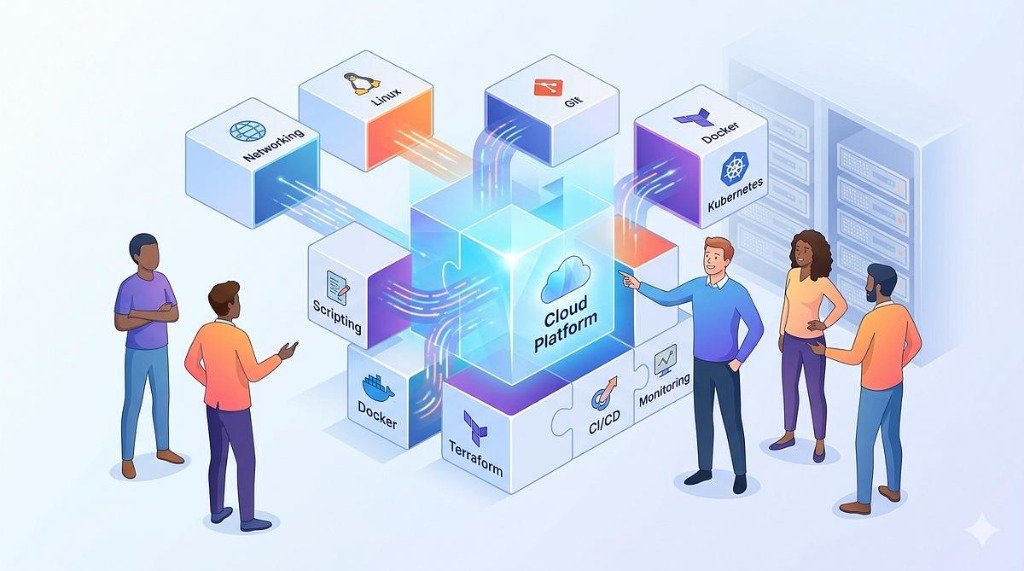
- Learn Linux fundamentals and networking basics.
- Master Git and GitHub.
- Learn a programming language (Python or Go).
- Study Docker and containerization.
- Learn Kubernetes.
- Understand CI/CD (Jenkins, GitHub Actions).
- Learn Terraform and Ansible.
- Study AWS, Azure, or Google Cloud.
- Practice monitoring with Prometheus and Grafana.
- Build real-world projects and contribute to open source.
Best Projects for Beginners
- Dockerize a simple web application
- Build a CI/CD pipeline using GitHub Actions
- Deploy a website on AWS
- Automate server configuration with Ansible
- Provision cloud infrastructure using Terraform
- Create a Kubernetes deployment
- Set up Prometheus and Grafana monitoring
Best DevOps Certifications & Resources
Valuable certifications: AWS Certified DevOps Engineer, Microsoft Certified: Azure DevOps Engineer Expert, Google Professional Cloud DevOps Engineer, Certified Kubernetes Administrator (CKA), HashiCorp Terraform Associate.
Free resources: Official Docker/Kubernetes/Terraform documentation, AWS Skill Builder, freeCodeCamp, GitHub Open Source Projects.
Frequently Asked Questions (FAQs)
Is DevOps difficult to learn?
It requires learning multiple technologies, but with consistent practice and hands-on projects, beginners can gradually build the necessary skills.
Do I need programming knowledge?
Basic programming knowledge, especially in Python or Bash scripting, is highly beneficial for automation tasks.
Which cloud platform should I learn first?
AWS is the most popular choice, but Azure and Google Cloud are also excellent options depending on your career goals.
Can I become a freelance DevOps engineer?
Yes. Many companies hire freelance DevOps professionals to automate deployments, manage cloud infrastructure, and optimize software delivery pipelines.
No comments yet. Be the first to share your thoughts!